
What Does a Digital Marketing Agency Do? A Complete Guide
A digital marketing agency plans and executes your online marketing, covering SEO, paid ads, social media, content, and email, so your business gets consistent visibility, qualified leads, and measurable growth. They handle the strategy, execution, reporting, and ongoing optimisation, while you focus on running your business.
But business owners searching “what does a digital marketing agency do” are not always curious about the services; they fear money-wastage. Either they have tried an agency that has not delivered the promised outcomes, or they know someone who has been ripped off.
Business owners have valid fears because, sometimes, digital marketing seems to be a black box full of awful surprises. That is where a good digital marketing agency comes into the picture, making the marketing easy. They can clearly explain what they are doing and the outcomes for your business. In this guide, we will break down everything for you about choosing digital marketing agencies in the UK.
So What Does A Digital Marketing Agency Do, Exactly?
A digital marketing agency does the marketing of your business across social platforms with the help of its team. They do everything from strategy to execution, reporting to optimisation for you, so you can scale your business in the UK and concentrate on building your brand. All the work is handled by a specific professional of the respective field, as a strong marketing team consists of strategists, SEO specialists, content writing experts, social media managers and now, as the technology is advancing, AEO experts. They all make sure that your marketing is relevant to your brand and audience, has a good performance and is aligned with your long-term growth goals.
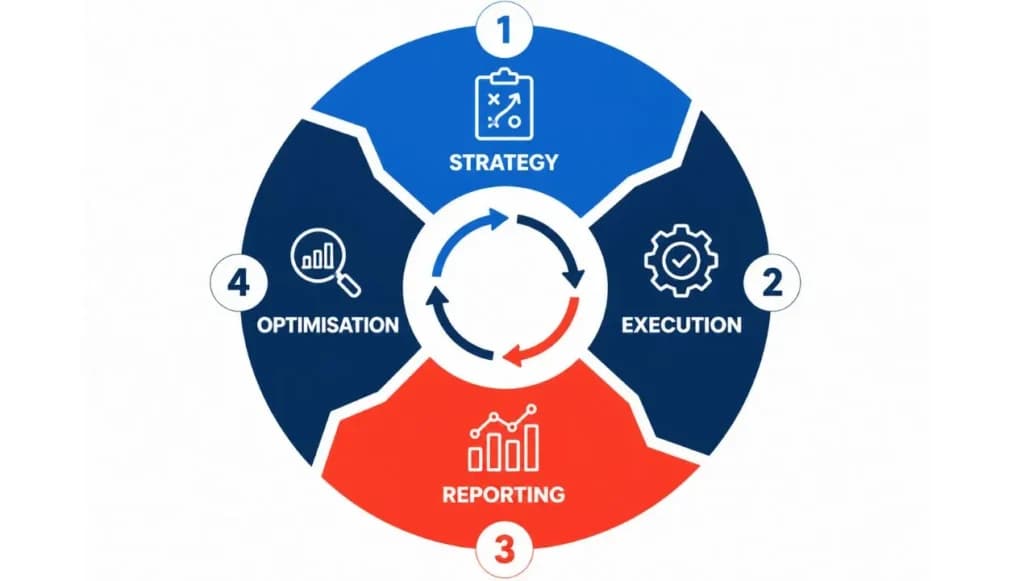
How Does An Agency Work Day-To-Day?
A reputable marketing agency that is long in the game will be asking more questions in the first few weeks than they are giving answers. That is to understand your business better and make a strategy that aligns well with your goals.
Strategy
Every outstanding campaign starts with a team that has a clear picture of your business: your goals, audience, competitors, and the channels most likely to reach your customers. For a UK business, this includes the local search trends and the online platforms that your target customers spend time on. This strategy is the starting point of every content, ad campaigns and SEO decisions.
Execution
Once the strategy is finalised, comes the execution stage. This means building or optimising your website, writing and publishing content, setting up and launching paid ad campaigns, scheduling social media, and sending email sequences; all planned around your brand, offer and audience.
Reporting
After the execution phase, the team monitors the performance of the campaigns. They figure out what is working and why, how it will be useful for your future strategy, in this phase. Good agencies rely on business outcomes like leads, bookings and revenue, not just vanity metrics.
Optimisation
In the optimisation stage, the team, after analysing the issues, works to fix them. All the campaigns are constantly monitored to make sure nothing is broken. It makes sure the visibility of your brand is long-term, not just a one-time spike.
Reasons Businesses Prefer Digital Marketing Agencies
Small businesses and even established companies reach a point where managing marketing in-house becomes difficult. It happens because modern digital marketing has become too complex and time-consuming to handle alongside running a business. There are a few common reasons for this shift:
- Effective marketing takes time; businesses are already handling operations, sales, and customer service, which often results in inconsistent or rushed marketing.
- Every platform works differently; what works on Google doesn’t necessarily work on Instagram or email. Repurposing content without a strategy often leads to weak results.
- Specialist skills are required for SEO, paid ads, content strategy, analytics, conversion optimisation, etc. Most internal teams don’t have depth in every area.
- Lead flow becomes unpredictable, businesses struggle with inconsistent enquiries; some months are busy, others are quiet, with no clear reason why.
- It becomes hard to measure what is actually working; data cannot turn into clear decisions without experience.
- Business owners end up doing too much at once, and marketing gets added on top of everything else, leading to burnout.
That’s usually the point where businesses start thinking about bringing in outside help, and honestly, it makes sense.
Services A Digital Marketing Agency Offers
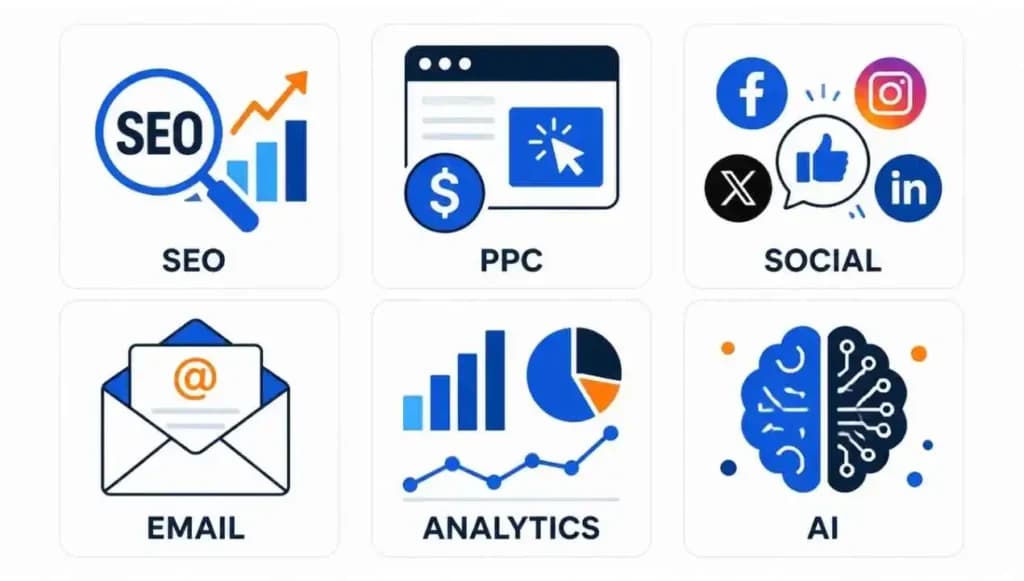
The digital marketing in the UK usually contains the following services:
Website Design & SEO
Website design and SEO are the core components of any digital campaign. Good design ensures users easily navigate and convert, while SEO helps the business to connect with its user intent and improves website ranking. SEO (Search Engine Optimisation) ensures your website appears when your ideal customers search for what you offer. According to BrightEdge, organic search drives 53% of all website traffic, making SEO one of the highest-ROI channels for UK businesses.
PPC & Google Ads
Paid online ads allow businesses to appear at the top of search results. Payment is only when a user clicks on their ad, so it is an accountable way to drive traffic. For UK businesses with a specific service area or seasonal demand, Google Ads can generate leads within days of launch.
Social Media Management & Paid Advertising
Social media management focuses on building organic community and brand presence, while paid ads deliver targeted messages to a specific audience; they drive traffic, leads and revenue. For UK SMEs, combining both gives you visibility at every stage of the customer journey.
Content & Email Marketing
Content marketing builds trust and brings in organic traffic over time, while email marketing nurtures existing leads and customers, with an average ROI of £36 for every £1 spent, according to the DMA UK. Together, they keep your business front of mind without relying entirely on paid spend.
Analytics & Performance Reporting
A good agency tracks the right metrics, like cost per lead, conversion rate, revenue per channel, and translates them into clear decisions. Tracking user behaviour and campaign performance ensures every dollar is spent on driving measurable growth and clear business objectives.
AI Search & Answer Engine Optimisation
More UK users are now searching through AI tools like ChatGPT, Perplexity, and Google’s AI Overviews instead of traditional search results. AEO structures your content so these platforms understand and cite your business as a direct answer. This includes using clear question-and-answer formatting, structured data markup, and authoritative content. It is one of the fastest-growing areas of digital marketing and one that most agencies are still catching up on.
What Does a Digital Marketing Do: A Realistic Timeline
One of the biggest frustrations UK businesses have with agencies is unrealistic expectations. Here is an honest timeline:
| Timeframe | What to expect |
| 0-30 days | Strategy, onboarding, account setup, initial audits |
| 1-3 months | Early SEO improvements, ads live, initial lead flow |
| 3-6 months | SEO rankings improving, paid ads optimised, leads becoming consistent |
| 6-12 months | Compounding SEO results, reduced cost per lead, measurable revenue growth |
Agencies promising overnight results are oversimplifying a complex process, as sustainable growth takes time and the results compound over time.

Behind The Scenes of A Good Marketing Agency
Clients only see the reports and the results, but here is what actually happens inside a well-run agency.
Team structure: A marketing campaign involves an account manager (your main point of contact), a strategist (who owns the overall plan), and a team of channel specialists. Each specialist focuses on their area while the account manager ensures everything is aligned and communicated clearly to you.
Weekly workflow: The team runs on structured weekly cycles: reviewing live campaign performance on Mondays, executing content and ad tasks mid-week, preparing client updates by Thursday or Friday. This rhythm ensures nothing is missed, and optimisations are made quickly if the performance dips.
Cross-channel thinking: The agency’s strength is joined-up thinking; SEO data reveals the user queries that are directly used in paid ad copy and content topics. High-performing email subject lines get repurposed as social media hooks, paid ad data shows which messages convert best, informing your website copy, etc.
Keeping up with change: Google updates its algorithm regularly, Meta changes its ad auction logic, and AI search is reshaping how people find businesses; a good agency monitors these changes continuously and adjusts strategy before performance drops.
You Might Need an Agency If…
Here are a few signs that marketing is difficult to manage for your UK business:
- You struggle with marketing consistency while managing everything else.
- You work on referrals and need a more reliable way to attract new customers consistently.
- You are too busy for marketing it gets pushed to the bottom of the to-do list.
- You are unsure which channels are actually working: social media, ads, or content.
- You have tried marketing, but there is no way to measure results
These are the points at which businesses seek external support for clarity, structure, and consistency in their marketing.

What Does a Digital Marketing Agency Not Do?
If you are researching “what does a digital marketing agency do,” it is equally important to understand what an agency cannot do for your business. Unrealistic expectations are the number one reason UK businesses feel let down by agencies. Let’s get it straight:
- They do not guarantee overnight results: Marketing takes time to build momentum, SEO typically takes 3–6 months to show meaningful results, paid ads can generate leads faster, but even they need weeks of testing before they perform consistently. A good agency sets honest timelines from day one.
- They do not replace your sales team or customer experience: An agency can get the right people to your website or landing page, but what happens after that is on you. If your sales process is slow, your follow-up is weak, or your customer service lets people down, no amount of marketing will fix it. Leads are only as valuable as the experience you give them once they arrive.
- They cannot fix a weak product or offer: Marketing amplifies what already exists, both the strengths and the weaknesses. If your pricing is uncompetitive, your reviews are poor, or your offer does not stand out in the UK market, a campaign will only make those problems more visible. The strongest results come when good marketing is paired with a genuinely strong product or service.
- They do not own your results; you do: A good agency builds systems, strategies, and campaigns, but your business owns the outcomes. This means staying involved, giving feedback, and making decisions when needed. Clients who treat agencies as a hands-off solution and disappear after onboarding see weaker results than those who stay engaged.
- Visibility is not the same as growth: Impressions, followers, or traffic are not business results, and a good agency knows this. If your agency only ever reports on reach and clicks without tying them to actual business outcomes, that is a red flag worth raising.
Clarity Before Hiring A Digital Marketing Agency
Once you understand “what does a digital marketing agency do”, ask these questions before making a hiring decision.
- Who will work on my account?
- How do you report results, and what metrics matter most?
- Do you outsource any of the work?
- Can you show me results for a business similar to mine?
- What does success look like in the first 90 days?
If they are not confident in answering these, you may need to rethink your hiring decision. Or, in case they are new to marketing and have no results to show, ask them about their process.
Conclusion
Searching “what does a digital marketing agency do” is not always about services, but realistic growth. A good agency brings structure to your marketing and what its outcomes are to your business. It is also important to understand what an agency cannot do. Marketing is not a shortcut to fix business issues; it does not replace strong products or effective sales processes. An agency can only help you with direction and consistency in marketing; choose one that values transparency and communication.