
EEAT SEO in 2026: Building Trust When Google Rankings Change
Your ranking is still where it was last month, but your traffic isn’t. This occurs when Google start citing your competitors in AI Overview instead of you. The EEAT SEO process manages the overall credibility, source quality, and trustworthiness of content, which directly impacts how Google chooses to rank it.
Getting your EEAT SEO strategy right involves building trust signals in the right order, beginning with signals that can be achieved in days and finishing with signals which will have lasting authority. This guide explains all of these signals: what each signal actually does, how long it takes, and where you’re falling behind your competition.
The EEAT SEO Myth: What Google Actually Says About Rankings
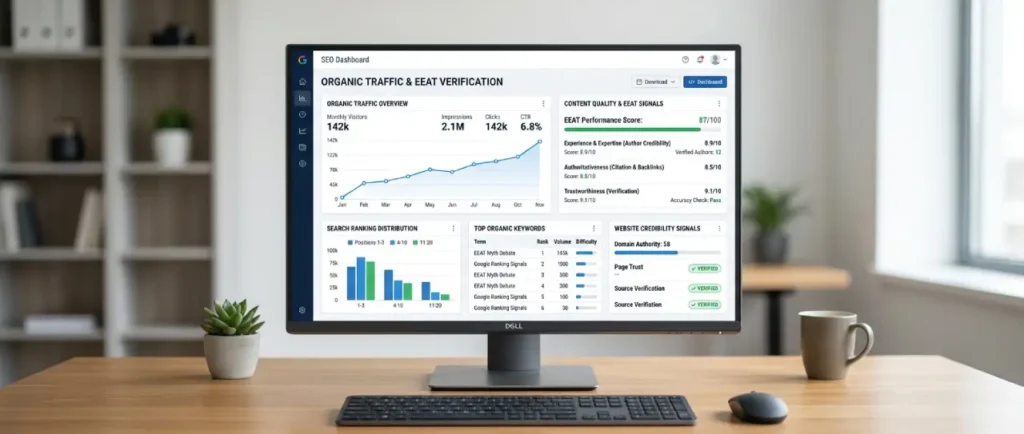
The truth about what most SEO companies don’t want you to know: EEAT is not a ranking signal. Google’s Danny Sullivan explained that there is no such thing as an EEAT “score”. It means that the concept is used by the quality raters when evaluating search results, not to rank individual pages. In 2025, John Mueller reiterated this point, saying you can’t “just sprinkle some experiences on the page.” It “doesn’t make any sense.”
Well, if EEAT is not a ranking factor, then why do all SEO agencies base their service on it? This is because four pillars correlate so strongly with ranking trust, actual expertise, and authority from third parties that targeting them will result in success, even though Google doesn’t measure them at all. The official EEAT SEO Google documentation itself proves the fact that trust is the most important member of the EEAT group, and the other three pillars lead to it. The single sentence is the entire logic of this guide.
This is where many guides get things wrong. It is said that non-YMYL websites, such as recipe blogs, software tutorials, and hobby sites, do not have to consider E-E-A-T at all. Not necessarily true. Trust is important no matter what kind of content you have on your site. A recipe blog without an author or verifiable history and a working contact page gets penalised not for incorrect recipes, but for lack of verification of any information on the site.
EEAT SEO Defined: Experience, Expertise, Authority, Trust
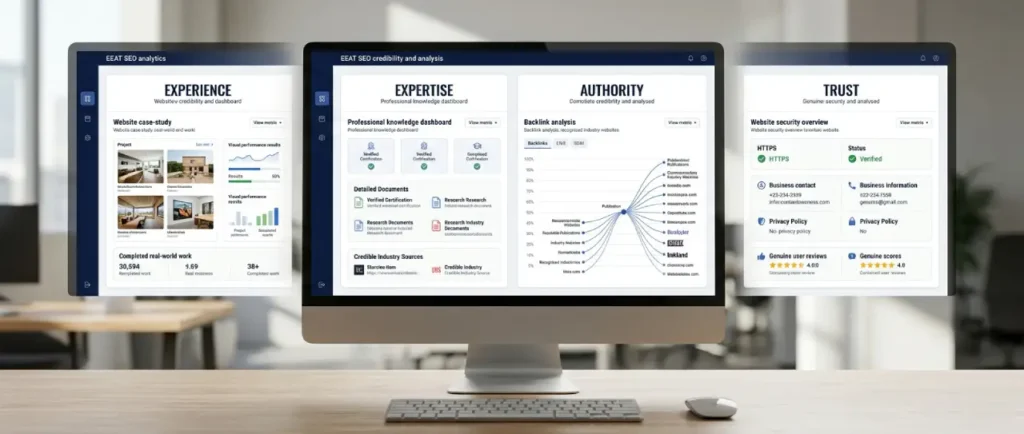
The EEAT concept of Google SEO consists of determining sources that can be considered reliable. Experience means that you have done the job. Expertise means that you have profound knowledge about it. Authority is when reputable sources approve you. Trust is when people believe you.
However, your competitors know this definition. They all say the same thing. Then they sell you their services to “build EEAT,” without telling you the exact order: you need to build Trust first (1-2 months), then Experience (3-6 months), then Expertise (ongoing), and then Authority (minimum 6-12+ months). The majority of agencies do not follow any order at all; they consider all those factors equal. That’s why they fail: they spread your budget thin across signals that should be prioritised sequentially.
Experience
Experience is evidence that you have done the job, not just claimed it, actually done it. A real UK estate agent who is showing 50 property sale cases with the date of renovation, photos of how the property looks before and after, sale price and even the name of the client (with permission) has an experience signal. A UK accountant who publishes cases with details of clients involved, how much he saved on VAT, and compliance issues resolved has experience indicators.
What do you do? Build experience signals through a unique photograph of your actual work and case studies that contain numbers and results. Show video testimonials of your team members doing work for clients and bios that show actual hands-on experience with delivery. These take time and money. These are the clearest EEAT examples Google’s quality raters are trained to recognise.
Expertise
Expertise is measurable knowledge. An unqualified but experienced financial advisor with 20 years of experience possesses poor expertise signals regarding YMYL. A recently certified CPA (accountant) possesses good expertise signals despite having little experience. Google favours credentials regarding YMYL content (health, finance, legal, safety). Credentials are optional for non-YMYL.
What do you do? Build expertise signals by going beyond surface-level explanations, which proves that you understand the nuance, edge cases and complexity. Referencing credible external sources, not only yourself or competing companies. Showing off your credentials clearly, such as your degrees or certifications. Keeping your old information updated regularly proves that you keep up with developments in the field.
Authority
Authority is an endorsement by credible sources, not by yourself or any claims, of you and your website. A single backlink from The Telegraph injects external trust that you cannot replicate with self-created internal links. A brand citation in Campaign magazine carries far more weight than mentions across low-tier blogs. Authority is outside of your site. It’s earned via relationships, not fabricated by claims.
What do you do? Your competitors have some backlinks. You need to beat them systematically. Guest posts in 3-5 industry blogs. Media coverage by trade media and appearance at industry events and presentation there as an expert (not as a stall visitor). Original research that’s valuable enough for others to link to because it’s valuable (not fabricated stats). Cooperation with complementary UK businesses for mutual endorsements. One backlink from a credible source has more authority than 50 from directories.
Trust
Trust comes first. Even if an untrustworthy website has the best experience, expertise, and authority, it will fail due to the lack of trust. Building trust indicators is the easiest and most overlooked approach for gaining competitive advantage: contact information (email, phone, postal address), HTTPS encryption (green padlock on every page), privacy policy in clear English (not a copied legal template), business ownership revealed (real names, real people, real positions), consistency across all channels.
What do you do? Build trust by providing contact details on every page. Enabling HTTPS on every page of your site, not just on the homepage. Writing a privacy policy in understandable language and showing your team members with their backgrounds and pictures. Providing information about your business registration, publishing real client testimonials with names and pictures and responding to each query within an hour.
Why EEAT SEO Matters in 2026: AI Overviews & Click Loss
Ranking position does not guarantee that users will find your website. The new feature of Google’s AI Overviews provides answers to searches right on the SERP without requiring users to visit sites. Google’s AI technology selects relevant sources based on the signals of authority and trust.
If your website ranks number 1 and does not have these Authority and Trust signals, it will not be cited by the AI. Users will see competitor company names in the overview. There was a significant decline in traffic in 2025 while rankings stayed stable due to AI Overviews.
EEAT SEO in 2026 is no longer about outranking others. It is about getting established as credible enough to get cited by AI. In this sense, backlinks, recognition in the industry, author attribution, and proven expertise matter in deciding whether AI cites the resource or not. Otherwise, a website may be unseen by users even if it holds the first position on search results pages. The difference is that Google selects sources for visibility.
Does Your Business Need EEAT SEO? YMYL vs. Non-YMYL
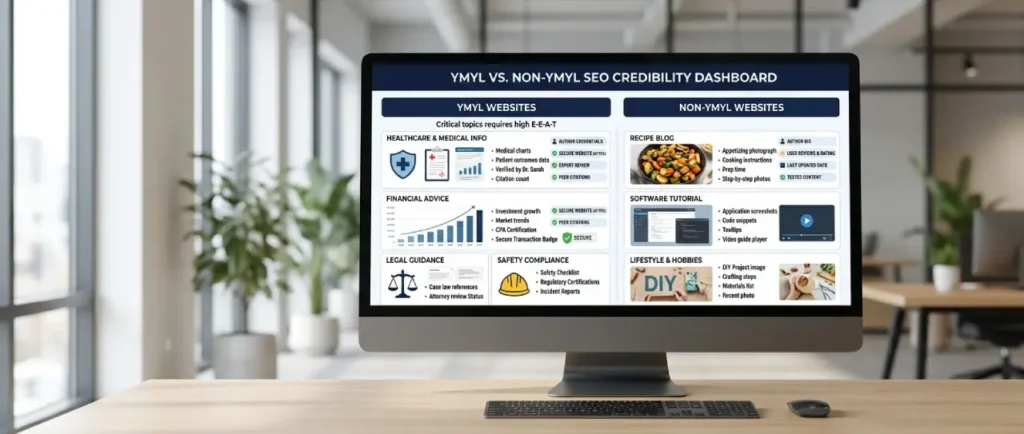
YMYL in SEO refers to topics where incorrect advice causes real-world financial, legal, or physical harm. Google divides content into two types: YMYL (“Your Money or Your Life”) and non-YMYL. Your specific chosen industry decides your baseline EEAT SEO investment level.
YMYL Topics: Where EEAT SEO Matters Most
YMYL consists of health, finance, law, safety, and life-changing decisions. YMYL is treated differently by Google because incorrect information can result in actual, quantifiable damage to users. The Quality Rater Guidelines (Google’s official guidelines) clearly mention that YMYL needs higher standards of expertise and authority.
“Regarding YMYL topics, we have heightened expertise and authority standards,” Google Search Central confirmed. To be active in YMYL, you need a relevant degree, certification, or license, or get an expert evaluation from somebody who has relevant credentials. There is no way around this. Your EEAT SEO baseline is non-negotiable and must be shown upfront to rank at all in these categories.
Non-YMYL Topics: What Still Applies
Non-YMYL category includes recipe blogs, product review sites (non-medical health), business advice sites, software tutorials, hobby sites, and lifestyle sites. Regarding non-YMYL, the EEAT SEO framework carries less weight in Google’s algorithms. However, there cannot be any relaxation regarding credibility. Recipe blogs do not require a culinary background, but should include a credible author, tested recipes, actual images, and reader feedback indicating the success of tutorials.
Software tutorial blogs do not require a degree in computer science, but should provide credible evidence of using the software and frequent updates to the tutorials. YMYL demands formal credentials, but non-YMYL demands proof of real work and user validation.
Building EEAT SEO From Scratch: Month-by-Month Roadmap
Can you build EEAT SEO for a 6-week-old website with no backlinks, no authority, and no citations? The answer is yes, but the timeline reality is a minimum of 6-12 months for material ranking impacts. Here’s what actually works.
Months 1-2: Build a trust foundation
HTTPS certificate is not negotiable (Green Padlock Mandatory). Visible contact info must be present, i.e., email, phone, and physical address. About page with your real background and reason for your business. Privacy Policy (Use templates and modify them). Terms of Service if you accept payment for anything. Author bio with real names, photos, credentials/experience.
Months 3-4: Show real results
Make some case studies about projects that you have done in the past. Give a before-and-after example with specific metrics. Get feedback from clients with their full names and company (where possible). Make sure to capture the process with images or video footage of your team working on the project. Share numbers, metrics and specific results. If you haven’t done any client projects as of now, make case studies of your own projects and share your results and learnings.
Months 5-6: Earn authority
Guest post on 3-5 relevant industry blogs (backlinks to your website). Write something unique and valuable enough so that other people will quote it. Get featured in industry publications, podcasts, or speaking panels. Work with related companies on backlinks and reciprocal promotion. Ask your clients to mention you in their own content and social media. This takes time, but it gives you credibility.
Month6+ ownword: Maintain and Scale
Authority does not happen only once and then is forgotten; it accrues over time. Get backlinks all the time. Continue to get media coverage through thought leadership. Make sure your content is updated regularly to reflect this. Add value by having more depth to topics that others will be linking to. Stay on top of what the competition is doing.

EEAT SEO Audit: Find Your Gaps vs. Competitors
Most businesses in the UK have a visibility problem, not an EEAT SEO problem. You have a competitor with the strongest Trust, Authority or Experience signals claiming the ranking you should have. This audit tells you exactly where the gap is and what to fix first.
Experience Audit
Check every important page on your site. Does it show proof of real work, original case studies, client outcomes, process photos, and named authors who actually did this work? If any person could have written your content by reading three other articles, it would rank like it too.
Go into Google Search Console, sort by your best-performing pages, and see which ones have no author attribution or first-hand evidence. Those pages are your Experience gap. Fix them with one verifiable proof point per page: a real result, a real client, a real process, not a stock image and a generic paragraph.
Expertise Audit
Pull out your top five ranking pages and then ask one question: does this content go deeper than the top three competitors on the same query? According to Ahrefs, the top 3 organic results capture 68.7% of all first-page clicks. If your content is lingering in positions 4 to 5, it means your topical depth isn’t strong enough yet to break into that top-tier traffic bracket, leaving the majority of your potential leads on the table.
For YMYL topics like finance, health and legal, check if author credentials are named, linked and verifiable. An author bio that says “Marketing Specialist” with no LinkedIn, no history and no qualifications listed is an expertise gap that Google’s quality raters are trained to flag.
Authority Audit
Type your brand name and your core topic into Google, for example “your agency name + digital marketing.” Count how many third-party pages are linking to you without you even asking. Zero mentions from credible UK sources mean your Authority signal is weak, no matter how good your content is.
Then check your backlink profile. Only 76% of pages cited in AI Overviews also rank in the top 10, meaning authority signals now determine AI citation, not just rankings. If you are getting links from low-authority directories rather than industry publications, that’s your authority gap.
Trust Audit
Just take this five-minute test. Are you sure you have the following features on your website:
- HTTPS support
- Contact page with an address
- Privacy Policy
- Business ownership is mentioned clearly
- Names of authors for all the materials
If not, make sure to take care of these issues first since they serve as the basis for all other EEAT signals. Another tool to find gaps in your website’s trust is Google Search Console. Pages that have a lot of impressions but no clicks at all mean that your title and description, as well as the trust in your brand, aren’t good enough.
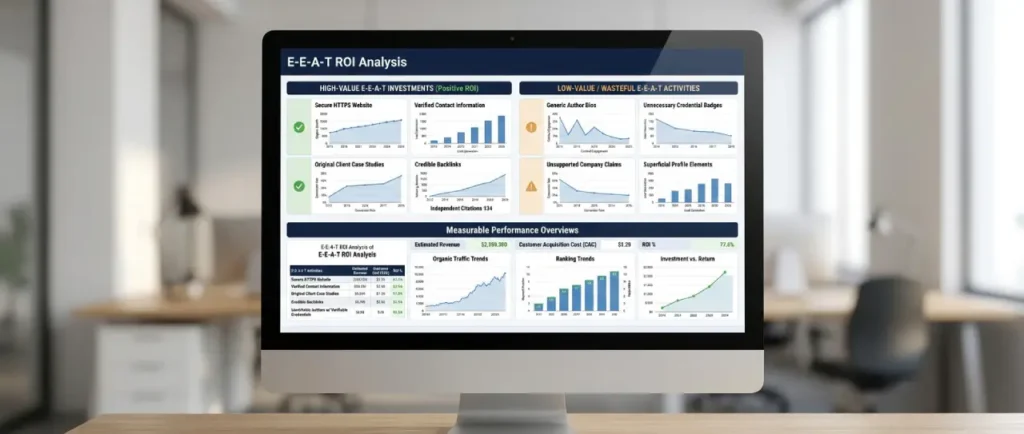
Is EEAT SEO Actually Worth the Effort? Honest Answer
You’re right to question it. Agencies promise to “add EEAT” to their pages, and Google confirmed directly that this is not how it works. E-E-A-T activities where companies spend money on polished bios, credentialing badges, and over-the-top team pages are all signals that Google knows are false and thus disbelieved.
The only EEAT activities with any ROI are those that can be independently verified by third parties. Your credibility rests with how others speak about you, not how you speak about yourself. Backlinks, media references, actual case studies, and identifiable authors with an independent track record all build up.
| EEAT action | Real ROI | Skip if your budget is tight |
| HTTPS + contact page + privacy policy | High ROI trust foundation | No. It’s non-negotiable |
| Named authors with verifiable credentials | High ROI, especially for YMYL sites | No, without it, Google distrusts anonymous content |
| Earning credible backlinks from UK sources | Highest long-term authority signals | No. This is your competitive moat |
| Original case studies and real client results | High ROI experience signals that compound | No. Best content investment available |
| Fake bios and inflated team pages | Negative ROI | Always skip. It actively backfires |
| Generic about us with no proof | Zero ROI | Skip, replace with verifiable proofs |
| Credential badges on non-YMYL content | Low ROI | Yes, invest time elsewhere instead |