

How Long Does It Take For SEO To Work? A Realistic Timeline
You have invested in SEO, and now you’re waiting for the leads to roll in. Without visible movement even after applying SEO strategies, it makes you wonder whether the investment is actually working. If you have been asking how long does seo take to work, it’s the right question to ask. The honest answer to this is that meaningful SEO results take between three and 6 months, depending on a range of factors.
This article gives you a complete, month-by-month breakdown. It will help you learn what to expect at each stage, what speeds up or slows down the process, and how to measure progress before rankings fully materialize.

How long does seo take to work: The Fundamentals
Before heading towards timelines, it is important to understand how long it takes for SEO to work. It’s not just a simple calculation. Search engines do not rank pages the moment they are published; instead, they crawl, index, analyse, and then test your content against thousands of competing signals.
Trust and authority are the two main aspects in your domain that Google’s systems rely on. This trust is built through consistent publishing, quality backlinks, positive user behaviour, and technical health signals. All of this doesn’t happen overnight. If you try to rush them artificially with spammy tactics, it often leads to algorithmic penalties that push you back even more.
SEO is not a campaign you switch on. It is a long-term signal-building process, and every month of consistent effort, publishing, and implementing the right strategies compounds on the last.
How Crawling and Indexing Delay Early Results
When new content is on the page for publishing, Google’s Googlebot still has to find and crawl it. For newer or low authority websites, this can take several days to weeks. Even once a page is indexed, it enters a testing phase. Google experiments with ranking it at various positions and analyses how users respond.
This is the reason why your SEO in Google does not produce instant visibility. Businesses wait for Googlebot to discover, evaluate, and promote their content. This process cannot be skipped, but can be optimised.
How User Experience Signals Impact Your SEO Timeline
Most competing articles often ignore the relationship between SEO and user experience. Google’s Core Web Vitals and engagement metrics, such as dwell time, scroll depth, and bounce rate, feed directly into how aggressively a page is promoted in rankings.

The SEO Timeline: What To Expect Month-by-Month
It becomes easier to break it into stages if you understand how long it takes for SEO to work. With every stage comes specific deliverables, measurable signals, and realistic expectations. This lets you know whether your campaign is on track.
Months 1-2: foundational and Technical Setup
The first two months are the backstage work. Your chosen SEO partner runs a technical audit in detail. Then resolves crawl errors, fixes broken links, compresses images, and aligns your site structure with best practices. Once the keyword research is completed, on-page elements like title tags, meta descriptions, and header hierarchies are corrected, and a content roadmap is built.
Significant ranking jumps can not be expected at this stage. You should always look for cleaner Google Search Console data, such as fewer crawl errors, improved Core Web Vitals scores, and new pages entering Google’s index. You can expect GBP impressions to begin climbing if your Google Business Profile is being managed as part of SEO for local businesses.
Months 3-4: Content Gains Attraction
By the third and fourth months, your content strategy starts producing visible signals. Long tail keywords with lower competition queries with specific intent begin appearing in your Google Search Console impressions report. Ranking positions start to crystallise, even if you may not be getting significant clicks yet.
At this stage, most businesses lose patience. This is not the point of giving up. The compounding nature of SEO means every piece of content published now will continue gaining organic authority for months.
Months 5-6: Momentum Builds, and Leads Begin
This is the stage where most businesses start to feel the investment they made earlier is paying off. Primary keywords enter page two and begin climbing towards the top ten. SEO results become prominent in Google Analytics. Organic traffic grows week-on-week, and the first leads attributable to search begin arriving.
For SEO for local businesses, this is often the time when consistent Google Maps Pack appearances begin. Call volume and direction requests from the GBP increase noticeably, especially if review generation has been running since the first month.
Months 7-12: Results Compound and Consistent Lead Flow
By month seven, your domain starts earning topical authority in your niche. Rankings stabilise across your target keyword clusters. Traffic starts growing steadily. It crucially leads from organic search to become a reliable, predictable part of your pipeline.
SEO here transitions from a cost centre into a business asset. The content that got published in the first two months continues to rank and generate leads without extra spend. Domain ratings grow, new content ranks faster, and the cost per acquired lead falls month on month.

SEO Timeline by Business Type and Industry
Timelines differ significantly depending on your business model. For example, a local plumber and a SaaS company are not doing the same SEO work, and their expectation should not be identical either.
Local Service Businesses
Local service businesses, such as those of solicitors, dentists, and electricians, usually see the fastest turnover. This is because the competition is geographically bounded. SEO for local businesses can generate map pack visibility within 60 to 90 days. This can be witnessed if Google Business Profile optimisation is paired with consistent review generation and local citation building.
For the first three months, the practical local SEO checklist includes completing every section of your GBP, ensuring your NAP (name, address, phone) is consistent across all directories, earning ratings and reviews weekly, and publishing local landing pages with town-specific content.
E-Commerce Businesses
E-commerce businesses face different kinds of challenges. Large product catalogues prone to duplicate content, thin category pages, and intense competition are the key areas that create issues for established retailers. Meaningful organic traffic for e-commerce usually takes six to nine months. The first revenue from organic search arrives around the eighth or ninth month.
The highest leverage moves from e-commerce are optimising category pages with unique descriptive content, adding structured data markup to product pages, and building a supporting blog that captures top-of-funnel informational queries from buyers early in the research phase.
For B2B and SaaS Companies
B2B and SaaS businesses compete for high-value, low-volume keywords that convert visitors into leads. These niches often have well-funded competitors with years of domain authority. This means realistic timelines run nine to eighteen months before organic search reliably contributes to the pipeline.
The winning strategy is topical authority clusters. This means publishing deeply interconnected content around the core solution rather than targeting isolated keywords. A SaaS company that becomes the definitive resource on a niche topic will consistently outperform one that chases individual keywords in isolation.
How does your budget affect the timeline?
It is directly influenced by how much you are investing and how the resources are deployed. A business investing £300/month in SEO will see slower results than a business investing £1500 per month. This is not because the strategy is better but because the output volume is higher. The more you invest, the more your content is published, the more backlink outreach is conducted, more technical fixes are addressed per month.
Entry-level SEO budgets (£300-£600/month) typically produce visible traction in six to nine months. Mid range (£800-£1500/month), compress that to four to six months. Growth-focused budgets (£2000+/month) tend to produce commercial results in three to four months when applied to a site with a reasonable amount of authority.
The conclusion that arises here is to match your budget to your competitive landscape. Underspending in a highly competitive market simply means you cannot outplace the investment level of your competitors, regardless of how good the strategy is.

How to Read Your Monthly SEO Report Like a Pro
Most businesses receive a monthly SEO report and have no idea whether the numbers mean things are going well or badly. Understanding what to look for transforms your relationship with SEO from blind trust into informed oversight.
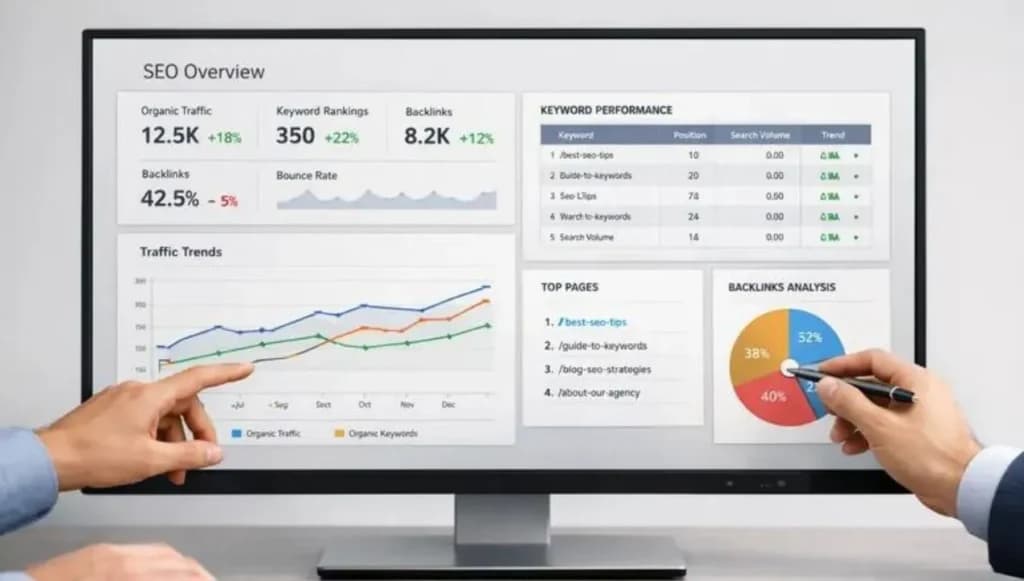
In the first three months, rankings and traffic are not the ultimate meaningful benchmarks. Instead, look at the indexed pages, Google Search Console impressions, Core Web Vitals scores, and technical errors. Metrics that matter from the fourth month onwards are that your monthly SEO report should start showing organic click growth and ranking position improvements for target keywords.
If your monthly report only shows keywords and rankings without connecting them to leads or revenue,e then you should always ask your agency to add conversion tracking and goal completions to the reporting dashboard.