

What is Technical SEO, And Why Does It Define UK Search Rankings?
Technical SEO is the primary source that helps search engines understand, crawl, and rank your website properly. For every other business in the UK, technical SEO affects everything from local visibility to leads, conversions, and AI-driven search results.
What is Technical SEO in 2026?
Technical SEO is the practice of optimising your website’s infrastructure so search and answer engines can find, interpret, and rank it effectively. It is not just about basic things like keywords or backlinks; it is about ensuring that the foundations of your website are strong and solid.
In 2026, the significance of technical SEO has increased significantly. Google’s crawlers are more sophisticated, and AI-powered search engines are now contributing as direct ranking factors. A well-written website that loads slowly on phones, lacks structured data, and has a broken redirect will eventually lose to its competitors.
For businesses that are currently investing in technical SEO services in the UK, the focus has shifted from only fixing errors. It now encompasses how your website interacts with search engines and the AI systems answering queries instantly for users, even before they click a result.

Why Technical SEO Matters for UK Businesses?
UK businesses operate in one of the most competitive digital markets in the world. Whether it is an e-commerce brand, a service company, or a B2B firm, their competitors are investing heavily in ensuring search visibility, and most of them are very tough to beat.
The uncomfortable truth is that most SEO strategies applied to businesses fail not because of poor links, but because of technical errors that prevent the overall content or site from ever being seen. Pages that are not indexed properly, websites that take way too long to load or local business listings with incomplete address details silently kill organic traffic.
It is important to analyse the market that you are competing in. The UK market has specific characteristics that make technical SEO relevant and meaningful. Mobile usage is high, with a large percentage of local searches, and voice search via smart speakers is more common in the UK than in any other European country.

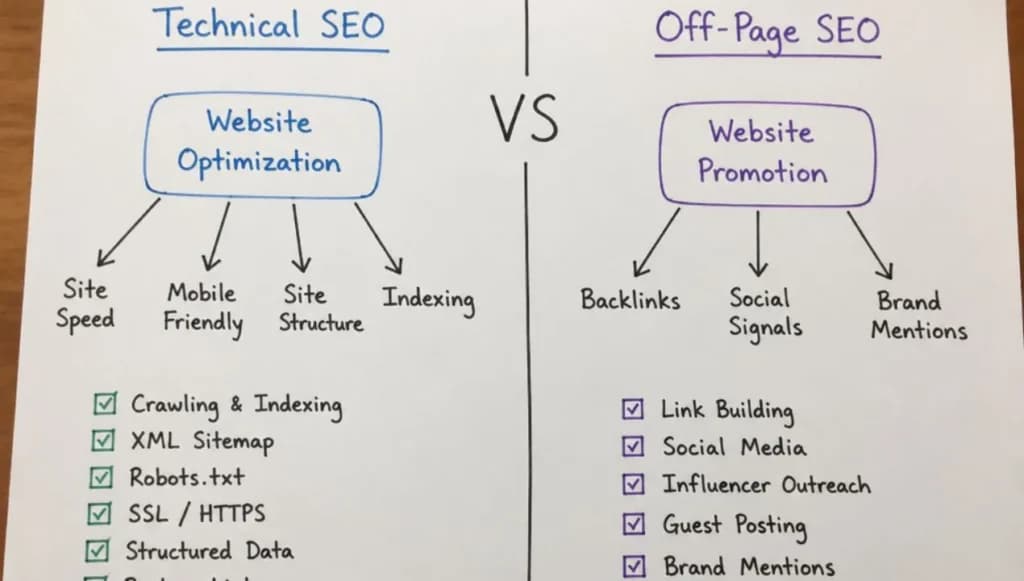
Technical SEO vs Off-Page SEO
| Factors | Technical SEO | Off-Page SEO |
| Focus | On-site infrastructure and architecture | External signals and authority |
| Key Activities | Crawlability, indexing, site speed, structured data, URL structure, Internal linking | Link building, digital PR, brand mentions, citations |
| Who It signals | Search engine bots and AI crawlers | Google’s authority and trust algorithms |
| Impact Timeline | Usually, faster fixes can show results within weeks | Slower link authority builds over months |
| Tools Used | Google Search Console, PageSpeed Insights, Sitebulb | Ahrefs, Moz, SEMrush, BuzzStream |
| UK Business Impact | Directly affects local pack, mobile rankings, and AI visibility | Affects domain authority and competitive positioning |
For UK businesses where local search is the primary source of leads, technical SEO is not just an option. It is the backbone of your website that helps it become visible on search engines.
The Effect of Technical SEO on Crawlability, Indexing, and Rankings
Search engines work in three steps: crawling, discovering your pages, indexing, storing and interpreting them, and ranking, deciding where they appear in results. SEO directly influences these three stages. This means a minor error at any of these stages can silently undermine your entire organic strategy.
Website crawlability refers to how easily Google can navigate your site. If pages are accidentally blocked in your robots.txt file, hidden behind login walls, or buried too deep in your website’s link structure, they may never be crawled at all. Google always follows links; if a page has no links pointing to it from the rest of your website pages, it may as well not exist.
Crawl budget optimisation makes sure Google spends its limited crawl allocation on your most deserving site pages. A page can be crawled but still excluded from the index if it has a noindex tag applied incorrectly or carries duplicate content, has been marked a soft 404 or is considered low-value.
Fixing crawlability and indexing allows rankings to follow, provided the content is relevant and competitive, then it does not undermine good content; instead, it ensures that good content gets the chance to be seen.

Technical SEO and Website Performance
Technical SEO and website performance are crucial for your site’s digital presence. They ensure that search engines can crawl and index your website, which gives users a seamless experience while browsing.
Page Speed and Core Web Vitals
It is no longer about only page speed optimisation. Google’s core web vitals: Largest Contentful Paint (LCP), Interaction to Next Paint (INP), and Cumulative Layout Shift (CLS) are essential ranking signals that reflect real user experience on your website.
LCP measures how quickly the content of a page loads. INP measures how responsive the page is to users’ interactions. CLS measures how stable the layout is, whether elements on the page coordinate with how the page loads. A site that is visually attractive but performs poorly on all three is not just technically at fault, but is frustrating users at the moment they land on your site.
Core web vitals for UK businesses matter because Google uses real-world data collected from Chrome in that region. A site that passes core web vitals does not just rank better, but it converts better too.
Mobile-first Indexing and Mobile Usability
Google indexes and ranks based on the mobile version of your website first. A lot of UK businesses are still facing a significant gap between their desktop and mobile experiences. If your desktop site is perfect, but alternatively the mobile experience is broken, like text too small to read without zooming, content wider than the screen causing horizontal scrolling, and buttons overlapping when needed to tap, your rankings will reflect the mobile version.
For this purpose, practical checks should be implemented. Practical checks include viewport meta tag configuration, font sizes smaller than 16px for body text, and testing how your navigation, forms, and CTAs behave on a range of mobile device sizes.
Fixing JavaScript and Rendering Issues
JavaScript SEO is one of the most overlooked areas, especially for UK businesses using modern CMS platforms. If your major content, such as product descriptions, service pages, and blog posts, is rendered client-side via JavaScript and Google cannot process it within a certain time period, this means those pages are nearly invisible in the index.
The safest approach is server-side or static side generation for content to rank. Where JavaScript is unavoidable, the URL inspection tool in Google Search Console allows you to test what answer bots see when they render your page. This often clarifies your doubts and presents a completely different report from what you see in your browser.

Technical SEO for Local UK Search
Local Business Schema and Structured Data
Schema markup implementation is a high-impact and low-effort strategy to witness technical improvements in a local business. Adding structured data SEO markup to your site, such as FAQ pages, local business, and review schema types, allows Google to understand what your business is, where it operates, what it offers, and customer experiences.
This is directly related to how your business appears across local search surfaces. Snippets in organic results, knowledge panels in the sidebar, and the local map pack results that dominate the top of the page for searches with local intent.
Location Pages for UK Service Areas
If your business operates across multiple cities across the UK, location pages are one of the most revenue-generating SEO assets you can invest in. If implemented properly, they capture local search intent at scale, such as “technical SEO services Manchester”.
Location pages must be genuinely unique. Google’s crawlers and AI overview engines identify thin and templated content quickly. Every page should mention local landmarks and regional industry clusters and feature testimonials or case studies of clients from that area.
NAP Consistency Across the Site and Directories
Name, address, and phone number consistency is the backbone of local SEO in the UK. Google cross-references your NAP data across your website, Google Business Profile, and third-party directories.
If a trading address differs from your business’s registered address, or an old phone number left on an outdated citation creates conflicting information. This sends mixed signals to both customers and Google about your business.
For multi-location businesses, it is necessary for each location to have its own consistent NAP set that is maintained independently. Conduct a NAP audit at least twice a year. This fixes inconsistencies in high authority directories first.

Common Technical SEO Problems UK Businesses Face
UK businesses face frequent and recurring problems that quietly suppress rankings.
Redirect Chains After Redesigns
Website redesigns are one of the most common factors that contribute to sudden ranking drops for UK businesses. When URLs change, every old URL must be individually 301 redirected to its new equivalent. When this is done carelessly, redirect chains form: URL A redirects to URL B, which then redirects to URL C.
Google follows chains up to a certain point, but page rank degrades with each hop, and Google wastes crawl budget navigating unnecessary redirects. After any redesign, it is highly recommended to run a full crawl.
Broken Internal Links
Broken internal links waste crawl budget and deliver a poor user experience. Both are highly relevant for technical SEO. When Google follows an internal link to a 404 page, it wastes one of its allocated crawl attempts on that domain.
For UK businesses that frequently update their service pages, case studies or blog content, broken links tend to accumulate quickly. Regular crawls catch these issues before they become ranking problems.
Parameter clutter and thin pages
For UK businesses, parameter clutter is a crawl budget optimisation crisis that takes place slowly and gradually. Google’s search console’s URL parameters tool allows you to specify how Google should handle specific parameters.
Thin pages, such as those with fewer than 300 words of unique and meaningful content, account for the problem. Google’s helpful content system deprioritises sites where a substantial portion of indexed pages offer minimal value.

Technical SEO in the Era of AI Search
Why Clear HTML Still Matters
Despite the rise of AI-powered search, well-structured HTML remains one of the most reliable foundations for ensuring your content is interpreted correctly. Proper heading hierarchy from H1 to H3, images, semantic HTML5 elements, and logically structured page layouts make it much easier for both traditional crawlers and AI bots to extract, understand and accurately represent your content.
Schema, Entities, and Machine Readability
AI search optimisation in 2026 depends on how well your website communicates through structured data and entity relationships. Structured data implemented as schema markup is not just about rich snippets in Google search. It is the primary mechanism by which AI systems, including Google’s AI overviews and third-party answer engines, understand what your business is, what it does, and who it serves.
Schema types with good impact for UK service businesses include local business, service, FAQ page, review and professional services. Technical SEO takes this a step further than just schema markup. It optimises your business as a clearly defined, machine-readable concept that is a specific company, in a specific location, offering specific services to a specific audience.
This is done through consistent use of your business name, structured data linking to your Google business profile and mentions on authoritative third-party sites.
AI Overviews and Answer Engines
Google’s AI overviews appear in a significant portion of UK search results. AI search optimisation requires a different technical angle from traditional SEO. Traditional SEO rewards keyword density and backlink volume, whereas AI overviews reward structured and question-answer type content that is machine-readable and attributed to a trusted entity.
For pages to be cited in AI overviews, they must answer questions directly in the opening paragraph, use clear heading structures that are relevant to common search queries and implement FAQ schema.