
What is LLM Optimisation and How It is Different From SEO in 2026
Your customers are moving to conversational AI search, and the brands appearing in those answers are not there by accident. But what is LLM optimisation, and why does it matter? ChatGPT, Gemini, Perplexity, and Copilot answer queries directly, without sending users to any website. AI systems choose their own trusted sources, and if your brand is not one of them, you are already losing to competitors. This guide explains what LLM optimisation is, why it matters for UK businesses in 2026, and exactly how to take action.

What is LLM Optimisation? How LLM Differs from SEO?
LLM optimisation is the process of making your brand and content credible enough for the AI answer engines to cite you. Unlike traditional SEO, LLM optimisation focuses on shaping how AI systems understand, represent, and cite your brand when users ask relevant questions.
What Does LLM Stand For?
LLM stands for Large Language Model, the AI systems trained on large datasets to understand human language and handle user queries, like ChatGPT, Gemini, Perplexity, Copilot, etc. When a user asks a query on any of them, the LLM generates the answer based on everything it has learned about your industry, competition or brand. LLM optimisation means influencing what a model knows and says about your brand.
How is LLM Optimisation Different from Traditional SEO?
Traditional SEO has just a simple goal: earn rankings on the 1st page of a search engine. For this purpose, you target keywords, earn backlinks and optimise your pages so that the algorithm places you above your competitors. But LLMs work differently, as they are generating answers, not ranking pages.
LLMs retrieve their answer from sources they consider authoritative, consistent, and clearly structured. A brand can rank on page 1 of Google and still be completely absent from ChatGPT’s responses. Equally, a smaller brand with strong entity signals and well-structured content can appear in AI answers ahead of much larger competitors.
While there are some differences in the goals of SEO and LLMO, they are still very much connected; think of it as a coin with two sides. You can not optimise a website for LLM visibility if the basic SEO structure is still missing. Many marketers now refer to this approach as LLM optimisation SEO, as it combines traditional SEO principles with AI citation and entity optimisation.
AEO, GEO, LLMO, Where’s the Difference?
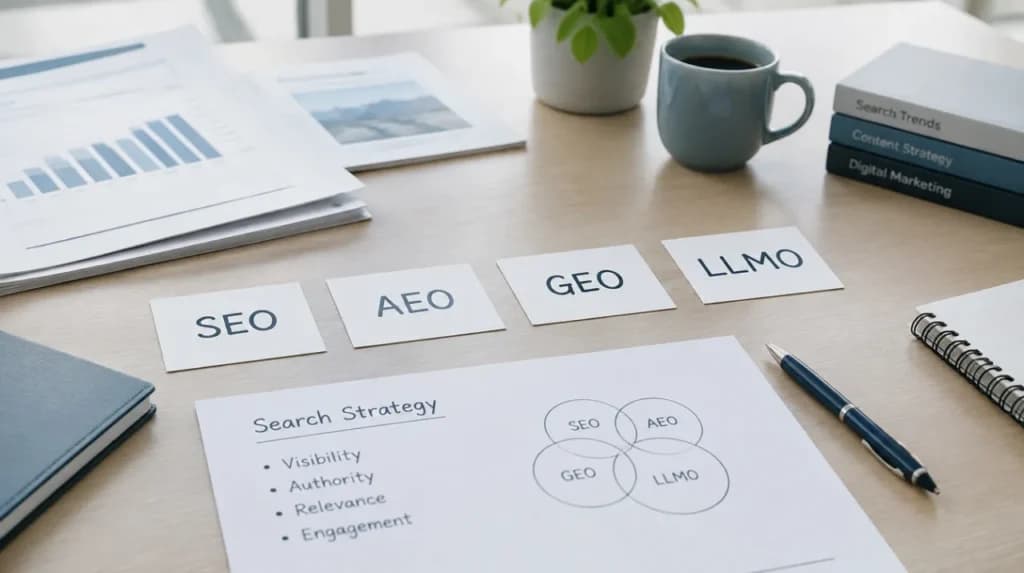
The terminology around AI search is genuinely confusing, and most guides either conflate these terms or skip the distinction entirely. Here is a clear breakdown of SEO, AEO, GEO, and LLMO:
| Term | Stands For | What It Does |
| SEO | Search Engine Optimisation | Improves Google/Bing rankings and organic clicks |
| AEO | Answer Engine Optimisation | Gets your content into featured snippets, voice results, and AI answer boxes |
| GEO | Generative Engine Optimisation | Gets your brand cited by generative AI platforms like ChatGPT and Perplexity |
| LLMO | Large Language Model Optimisation | Shapes how LLMs understand and represent your brand at an entity level |
| AI SEO | AI Search Optimisation | Umbrella term covering all of the above |

Why LLM Optimisation Matters for UK Businesses in 2026
The LLMO is not just a buzzword; in modern digital teams, LLM optimisation marketing is an essential part of brand visibility strategies. Here is the reality many UK businesses still overlook in 2026:
Numbers are louder
In 2024, over 59% of all Google searches ended without a single click; for searches that triggered an AI Overview, that number climbed to 83%. ChatGPT now processes over one billion queries every week; Perplexity generates 20 million AI answers every single day. Google’s AI Overview appears on nearly 40% of commercial searches. AI is now answering user queries without even sending them to a single website, choosing its own sources with no regard for Google’s rankings.
Increasing citation gap
Recent studies show that only 50% of Google’s top-ranking pages overlap with the sources AI systems actually cite. That means half of AI citations are going to brands that are not even winning in traditional search. In marketing language, you can simply put it this way: if your content looks good on Google and disappears in AI Overviews, stop optimising for keywords and start optimising for citations. LLMs care about who the internet trusts, not who has the best metadata.
Opportunities for UK businesses
Brands that began building entity authority and citation signals 12 to 18 months ago are already being treated as default sources by AI systems. Most UK competitors have not moved yet; the brands that act now will have a compounding advantage that becomes very difficult to close later.
What is LLM Optimisation Technique (That Actually Works)
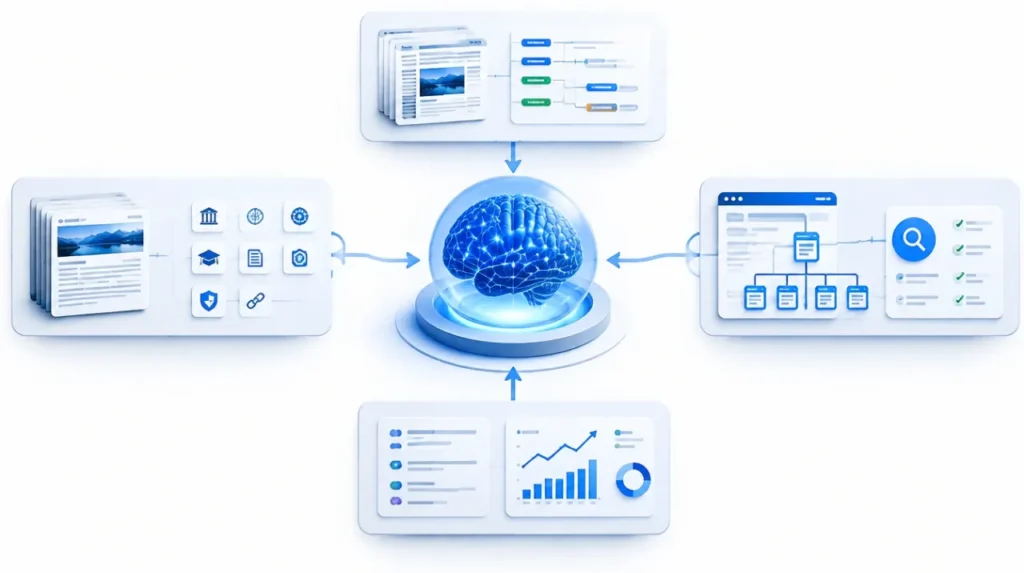
Effective LLM optimisation techniques improve how AI systems understand, trust, and cite your brand in generated answers.
Structured, Entity-Rich Content
LLM content optimisation focuses on creating clear, structured, answer-first content that AI systems can easily understand and cite. AI systems struggle to pull an answer from your content if it’s not structured properly; here is what you can fix:
- Use your brand name, products and services consistently across every page; it will help LLMs build the internal model of your brand
- Define terms clearly and early on relevant pages; AI systems favour question-based and answer-first content
- Structured content is easier for AI crawlers to parse and attribute, so make the content skimmable (use headings hierarchy and short paragraphs)
- Implement FAQ, Article and Organisation schema markups; they will give the AI machine-readable signals about your content.
Content Optimisation for AI Answers
The most cited content in AI responses is the one that answers the questions directly in plain language in the first 40 to 60 words. Also called the inverted pyramid format, in which the answer comes first, with the supporting evidence followed by a broader context. Many UK businesses do the exact opposite when writing web content, where the context and background come before the actual answer. You can optimise your content for AI answers by following these steps:
- Pinpoint the user questions in your niche with Google’s People Also Ask section and tools like Answer The Public and AlsoAsked.
- Write a direct 50-80-word answer to each question at the top of the relevant section in the content for AI to cite. (Pro tip: you can use these questions as the subheadings in your content)
- As LLMs are trained on human conversational data, using natural tone in your content will improve your chances of AI visibility.
- Include the FAQ section and the FAQ schema in your key pages; they will help your brand appear in Google’s AI Overviews and voice search results.
Build Brand Authority Across the Web
LLMs draw on everything publicly available for a brand: press coverage, third-party reviews, industry directories, forum discussions, Wikipedia entries, and social profiles. If your business consistently appears on credible external sources, the model starts to trust the authority of your brand. Here comes the Digital PR for brand awareness in the LLMO strategy:
- Earn mentions in publications and platforms that carry weight in your industry; they will act as citation signals to reinforce your authority with AI systems.
- Build a presence on forums and discussion platforms relevant to your sector, as they are sources of LLM training data: Reddit threads, industry communities, and Q&A platforms.
- Consistent brand information across all external platforms: your Google Business Profile, industry directories, social profiles, and third-party review sites should all present the same name, description, and positioning
- For larger brands, consider a Wikipedia page or a clear Knowledge Graph entry; the strongest entity signals available.
Technical SEO Still Matters
A common misconception is that LLM optimisation replaces traditional SEO. LLMs are trained on indexed, crawlable web content. Pages that are slow to load, poorly structured, or blocked from crawlers are less likely to be represented in AI training data. Strong technical SEO is the foundation that makes everything else work:
- Make sure your priority pages are crawlable and indexed. You can use Google Search Console to identify and fix crawl issues.
- Implement llms.txt on your domain. This signals AI crawlers how your content is structured and what they are permitted to use
- Use clean URL structures and internal linking, as it helps both traditional search engines and AI systems understand the connection of your pages.
- Keep priority content up to date; AI systems favour recency, and content that has not been refreshed in over 12 months is less likely to be treated as a current, reliable source.
Monitor & Measure Your AI Visibility
Businesses in the UK are unaware of their AI citation gap till the revenue starts dropping; by then, competitors have already established themselves as the default sources. Measurement needs to start now, before you can clearly see the problem. Here’s what to track:
- AI Share of Voice: How often does your brand appear in AI responses compared to competitors? Start by manually prompting ChatGPT, Gemini, and Perplexity with the questions your audience is most likely to ask, and document the responses.
- Citation rate: Is your content being referenced as a source in AI responses? Perplexity shows its sources directly, making it a useful monitoring tool.
- Featured snippet and PAA ownership: Track which of your target queries trigger a featured snippet or People Also Ask result, and if your content holds those positions
- Brand mention: When AI systems do mention your brand, how are they describing it? Accurately? Favourably? At all? (Pro tip: use the AI systems that are not connected to your business accounts)

Tools to Help With LLM Optimisation
You cannot handle full LLM optimisation with a single tool, or just tools alone, but these tools are worth knowing:
SE Ranking
SE Ranking is a cloud-based SEO and digital marketing tool, helping UK businesses track website keyword rankings, audit site health, analyse competitor backlink profiles, and research keywords. It also includes an AI Overview tracker to monitor which of your target queries trigger an AI Overview and if your content appears in it.
Semrush
Semrush’s AI Toolkit and brand monitoring track mentions across the web and identify opportunities for citations. The Copilot feature shows LLM recommendations with the traditional SEO data.
Brandwatch
Brandwatch offers enterprise-level brand monitoring that tracks mentions on news, social, and UGC platforms. The Search Intelligence Hub feature in Brandwatch offers purpose-built modules, allowing brands to monitor and shape how top AI models cite them.
Perplexity (as a monitoring tool)
Perplexity displays its sources directly in every response, making it the most transparent way to check if your content is being cited. Running manual monthly prompt audits in Perplexity can help you identify the gaps quickly.
Google Search Console
GSC is the most useful tool for monitoring your LLM visibility; featured snippets, crawl coverage, and structured data errors are all visible here.
Conclusion
AI search is changing how customers find businesses, and brands that fail to adapt risk becoming invisible in the generated answers. The good news is that if you are already searching for “what is LLM optimisation”, you are way ahead of most of your competition that are still unaware of this new search shift.
LLM optimisation is not here to replace SEO; in fact, it is the deep layer of it. The brands that will dominate AI search in the next two to three years are the ones building structured content, authoritative entity signals, and consistent cross-platform presence right now. Start with a free audit of what the LLMs are saying about your brand currently, which will direct you to the gaps and chances of improvement.