Best AI Visibility Tracking Tools For Every Business Type in 2026
Your rankings are holding, and traffic looks stable. Meanwhile, ChatGPT just recommended your closest competitor to someone ready to buy, while you were not even in the answer. That’s exactly what AI visibility tracking is built to catch. In this guide, we’ve broken down the best tracking tools for AI visibility by business type, so whether you are running an agency, an in-house SEO team, or flying solo, you know exactly where to start.
What Does AI Visibility Tracking Measure?
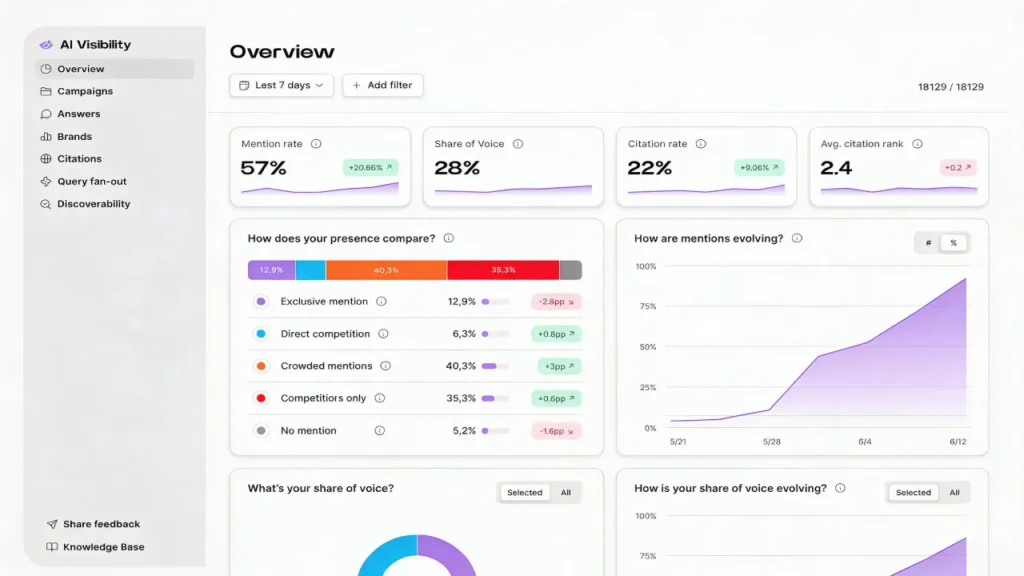
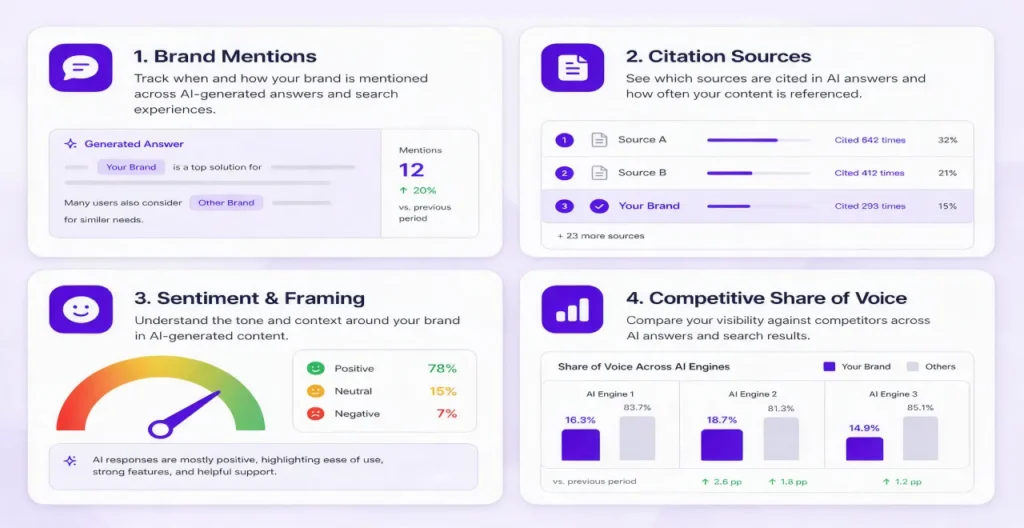
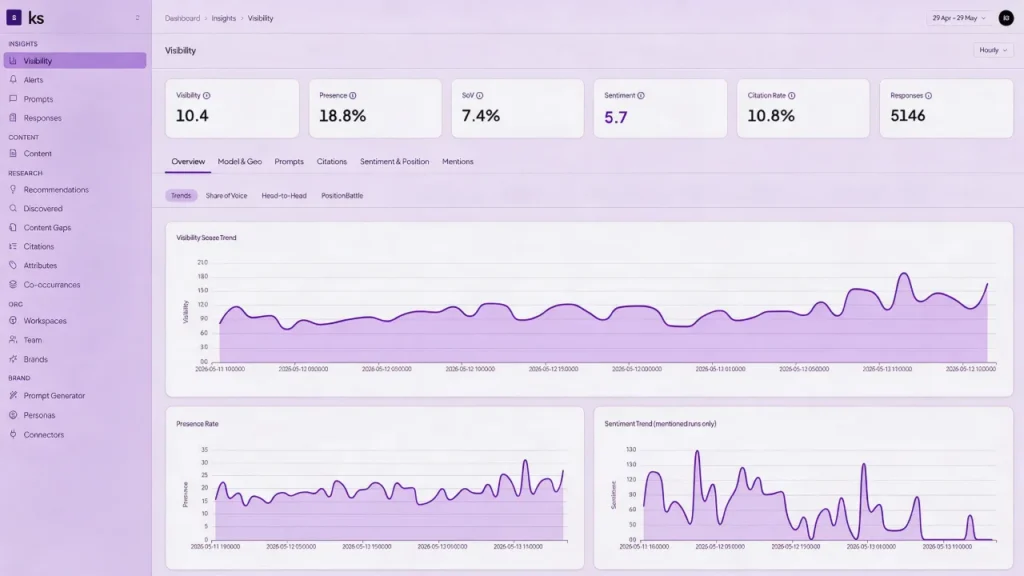
Measuring AI visibility tells you how often and in what context your brand appears in AI-generated answers. It not only shows if you are mentioned, but whether you are cited as a source, the context is positive, or your competitors are getting more airtime than you. Here is an AI visibility tracking success metrics table, most tools measure and what it means for you:
| Metric | What does it tell you |
| Mention rate | How often does your brand show up in AI answers |
| Share of voice | Your mentions vs. competitors across the same prompts |
| Citation rate | How often does your website get linked as a source |
| Sentiment | Whether AI describes you positively, neutrally, or negatively |
| Position | How central your brand is within the answer, first mention or buried |
| Coverage | How many of your tracked prompts actually trigger a brand mention |
The Actual Process of AI Visibility Tracking
The process of tracking AI visibility is quite simple, but equally important. Once you see the process, you’ll understand the use and limits of it:
Build your prompt set
Make a list of queries relevant to your business that a customer might ask in ChatGPT or Perplexity, like “best CRM for small businesses” or “what’s the top project management tool for remote teams.”
Run prompts in AI platforms
Run the prompts with the help of the tool in the AI search engines you are tracking: ChatGPT, Gemini, Perplexity, Claude, Google AI Overviews, and collect the responses.
Detect mentions, citations and sentiments
The tool then scans these responses for your brand name, website URL, competitor mentions and the tone in which you are described.
Track trends over time
A single result means very little; more value is in tracking the mention rate after a content push, or if a competitor is gaining more citations for prompts that used to favour you.
Finally, the manual list of prompts is just the starting point; AI internally generates a fan of sub-queries before producing an answer. The fan map-out queries can be related to angles, comparison questions or problem-framing queries. Mature tracking programs work by building prompt clusters due to these internal sub-queries.
Also, AI answers are not stable; the same prompt can return different results on different days, different devices, or different API calls. It is not a tool bug; the large language models work this way. Your visibility score can be measured as a range over time rather than a fixed number. That is why weekly trend tracking is more meaningful than a one-time snapshot.
Best AI Visibility Tracking Tools (2026)
There are many AI visibility tracking software tools, but which one fits your business model is the real question. The tools here are arranged by business type to help you find your pick:
Best AI Visibility Tracking Tools for Agencies
If you are managing AI visibility for multiple clients, you need the tools that can handle all the work perfectly for each of the businesses. You will be needing white-label reporting, multi-client dashboards, and tracking competitors in different industries, all at the same time.
Peec AI
Peec AI is a GEO analytics platform, tracking how brands appear in AI search engines like ChatGPT, Perplexity, etc. For agencies, Peec AI provides: client SOV tracking, competitor benchmarking, prompts that drive traffic, and multiple shareable client dashboards. The starting plan of Peec AI for agencies is £185/mo, with more growth-focused and customised options in a greater price range.
Nightwatch
Nightwatch is a dual-layer SEO and AI visibility tracking platform for agencies to monitor brand mentions across AI platforms. It tracks AI citations, measures visibility, and connects AI mentions with organic SEO performance through a unified dashboard. Nightwatch offers prompt research, automates reporting with white-label reports, and streamlines workflows with the NightOwl AI Agent. The starting price of Nightwatch for agencies is £68 /mo.
Tools Best for SEO Teams
For integrated SEO teams, the best AI visibility tools must bridge the gap between SEO metrics and real-time tracking of AI-generated answers. Unified tools offer actionable optimisation workflows without adding friction.
Semrush AI Toolkit
The Semrush AI Visibility Toolkit helps SEO teams track and improve their brand’s presence on AI-powered search engines and chatbots. It combines AI visibility scoring, prompt-level tracking, competitor benchmarking, sentiment analysis, and audience insights with traditional SEO data in one platform. Integrated Google Analytics reporting connects AI mentions to traffic and conversions, making ROI easy to measure. Best suited for existing Semrush users, it extends keyword tracking and competitive intelligence with AI citation analysis, starting at £75/mo.
SE Ranking
SE Ranking’s AI Visibility Tracker enables teams to track rankings and brand mentions across AI in one tool. It offers competitor benchmarking, source URL detection, and a unified dashboard that helps content and SEO teams optimise for both search engines and AI-driven discovery. Included in standard SE Ranking plans starting at around £37/mo, making it a cost-effective solution for integrated SEO workflows.
These tools only work best for teams that already have integrated SEO, but if you want more advanced AI visibility tracking, you may need a specialised platform.
Tools Best for Small Teams or Solo Use
You don’t need a big budget for tracking AI visibility; there are specialised and affordable tools like
OtterlyAI for small teams and solo use.
Otterly AI
Otterly AI tracks brand mentions on AI platforms, and the user interface is also beginner-friendly. The pricing is also very affordable. Otterly AI is good for you, starting at £21/mo, if you want to know your standing in AI-generated answers without committing to an expensive platform.
Trackerly
Trackerly comes in at a similar price point, £25/mo, and covers the core metrics without a steep learning curve. For solopreneurs or small marketing teams doing their own GEO work, it gets the job done.
Best Enterprise AI Visibility Tracking Tools
If you are at a scale where you need to track hundreds of prompts across multiple markets, in multiple languages, with exec-level reporting built in, the enterprise tools are for you.
Profound
Profound tracks AI visibility on all major platforms, handles large prompt libraries, and reporting is easy to understand for SEO teams and stakeholders. The pricing reflects the enterprise positioning that offers custom solutions.
Evertune AI
Evertune is more sentiment and brand narrative focused. It is useful for brands that have concerns more than just mentions; they want to be described accurately and consistently. The starting price of Evertune AI for enterprises is £600/mo.
Tools Best for B2B Businesses and In-House Teams
According to research, 73% of B2B buyers use AI to shortlist vendors; if you are not in the answer or AI is not describing your brand accurately, you are losing potential sales. B2B AI visibility tracking makes sure that when a buyer asks ChatGPT or Perplexity about your category, your brand shows up correctly.
HubSpot AEO
HubSpot AEO is a tool that measures AI visibility, brand sentiment, competitor share of voice, and query performance across major LLMs. The platform also connects AI-driven traffic to your CRM for attribution and lead tracking. Basic packages at HubSpot AEO start at £37/mo, with limited daily prompts, but you can always purchase add-ons.
Gracker AI
GrackerAI is built exclusively for B2B SaaS companies, tracking up to 9 AI engines, with industry-specific models for fintech and dev tools. Gracker AI has a built-in content engine for AEO-optimised content, starting at only £59/mo.
How to Choose the Right AI Visibility Tracking Tool?
Before choosing any tool for tracking AI visibility, ask yourself these questions first:
- Which AI platforms do you actually need to track?
A single tool can not cover every platform, and you do not need to cover every platform; just focus on the ones your audience uses most. If your audience uses Perplexity, you cannot just gather the data from Gemini. Always check the platforms included in the tool.
- How many prompts do you need to track?
If you are in a competitive niche with lots of relevant queries, calculate if the tools’ plan limits will work best for you.
- Do you need competitor tracking or just your own brand?
Some tools are brand-monitoring focused, while others let you track how competitors appear in the same AI answers. If you want the competition data, confirm if this is built in.
- Will you act on the data, and what will be the role of the tool in it?
A lot of tools give you a visibility score, and that’s it; the more useful ones show you what changes help in visibility improvements. The best tool will help you find the prompts you are missing and where your competitors are getting cited instead of you.
- What’s your budget, and what does it get you?
Tools also have a capacity gap; a £25/month tool and a £500/month tool have different prompt volume, platform coverage and reporting depth. Be clear about what you need now or what you might need in the next six months.
Conclusion
The concept of AI visibility tracking is still under development, and so are the tools. Honestly, tools just give you a picture, as the AI answers vary, and you can never fully determine which prompt or query might mention your brand.
Tracking just gives you a direction, whether you are gaining or losing ground in AI-generated answers. It tells you exactly where your competitors are outpacing you or which change can move the needle for your brand.
Start simple; pick a tool that fits your current scale, set up a manageable prompt set, and track weekly. The signal gets clearer over time.