
10 Reasons And Their Fixes For Why My Competitor Is Ranking Higher
Your service is better, and your clients are happy, but a competitor still sits above you on Google. The cause is rarely the quality of your work. Google ranks pages, not businesses. Your competitor ranks higher because Google thinks their page answers the search better than yours.
This guide from 360 Web Solutions shows you how to check 10 possible causes, score your page against theirs, and choose the right fix to start with.
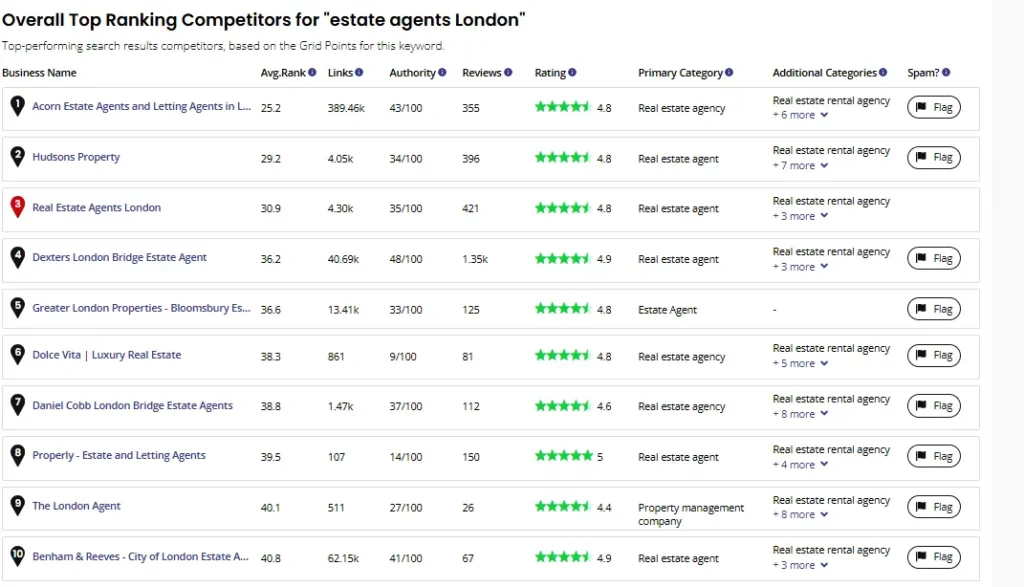
Why Is My Competitor Ranking Higher? 10 Gaps on Your Page
There are the most important reasons that can make your competitor rank higher than you for any query, which are given below:
1. Search Intent Match
A page only ranks when it meets the user’s search criteria. When the page fulfills what the user wants and their purpose of doing a search, then it ranks higher than yours, which may not have fulfilled the user’s search intent.
For example, take the keyword “digital marketing agency London” for research. The people who are typing this word want to hire someone. Google will show the researcher a service page that has done good local SEO and has proper pricing and a clear get-in-touch option. On this query, a 3000-word blog post will not rank.
You can check your page by
- Search your main keyword and note down the top five SERP pages.
- Compare what each page offers before the reader scrolls down.
- Also check that the next step is written after the answer to the main user query
2. On-Page Optimization
Google reads your title, H1, and subheadings first to work out what a page is about. If your competitors say it clearly and yours stay vague, their page gets matched to the search faster.
If we compare Home|Smith Digital with the SEO agency in London|Smith Digital, then you will see the second one tells the search engines and users clearly what the page offers.
How to Check
- Compare your title and H1 with the top competitors.
- Look for the main keyword in the title, H1, and first 100 words.
- See that your headings use the relevant keywords for the customers actually searching.
- Check the pages on your site that target the same keywords and compete with each other.
3. Better Content Depth
Your competitor can win when their page answers more of the questions a reader has. But in content coverage, length doesn’t matter because a short page that covers the topic fully beats a long page that only repeats the content.
Let’s suppose a user searches, “How long does SEO take to rank the site?” Page A only tells them it depends on many factors and moves on. But page B tells most sites to see movement in about 90 days. It then explains what factors speed up the ranking and what slow it down.
How to check
- List every question that their page is answering.
- Enlist the examples and steps. Figures and FAQs from their page that are missing on yours.
- Read out both pages and note which content fills the customers’ requirements.
4. Stronger Backlinks
Backlinks play an important role in content. Google notes the authority through domain rating, which increases due to backlinks. If your competitors have taken backlinks from high-authority and highly relevant websites, then Google gives priority to those websites. Better content does not always close that gap.
You can get the idea from this example: a page for “How long does SEO take to rank a website with proper backlinks from an industry blog, a news site, and a business directory?” will rank easily. But on the other side of your page, there are no links at all that prove Google thinks the first page is trusted, as it has links from authoritative websites.
How To Check
- Look at the links pointing to their ranking page, not only their homepage.
- Note where those links come from (industry sites, press, partners).
- Compare the number of referring domains, not the total link count.
5. Brand and Domain Strength
If a site has a clear structure, then it shows Google which page is important. Competitors often link their service pages to the supporting blogs, and those blogs link back. Internal linking to the relevant blogs and services increases the website’s trustworthiness, and this network tells Google we have deep command of the topic.
How to Check
- Their blogs are linked to the service pages.
- Check your pages’ internal linking strategy and write down those pages that are not interlinked.
- Note down how many clicks it takes to reach their service page from the homepage.
6. Clearer Site Structure
We cannot say low page speed affects rankings, but it frustrates visitors, and many leave before the LCP loads. If two pages are giving the same answers but one loads faster, then it will rank easily.
7. Faster Page Experience
We cannot say low page speed can affect the ranking, but it frustrates visitors, and many leave before the LCP loads. If two pages are giving the same answers but one loads faster, then it will rank easily.
If yours is slow and the large Contentful page is taking more than 2 seconds, that is a standard loading speed for a site. Then your competitor will rank above you due to faster loading speed, and users will prioritize that site.
How to check
- You can check your site speed through PageSpeed Insights on mobile.
- See your Core Web Vitals report in Google Search Console.
- Check that the images are correctly sized, as the hero image dimension is 16:9 and the general content image is 1200 x 800 pixels.
- Open both sites one by one on mobile and note their loading behavior.
8. Higher Click-Through Rate
There are chances two pages have the same content, backlinks, and page speed loading approach, but one is getting more clicks than the other. This click difference tells Google that the site getting more clicks is trusted, as users are opening it frequently.
For example, you search for an SEO agency in London and see two different titles; one is Home Smith Digital, and the other reads as “SEO Agency in London | Free audit and clear pricing.” Most probably, users will click on the second because it says what the user will get before they open the page.
How to Check
- Compare your meta titles and description with competitors.
- Look for the review stars or other results under their listing.
- Check the click-through rate for your page in Google Search Console.
9. Local Search Strength
For local searches, Google Maps results follow different rules than the normal results. A business with fewer reviews can still outrank you in the map pack. If someone searches “SEO agency in East London,” then Google will pick the business that has a proper Google Business Profile and is closest to the searcher.
How to Check
- Compare your primary Google Business Profile category with theirs.
- Check how close their addresses are to the area you are testing from.
- Complete an audit of their GBP and see if they have proper reviews, services, photos, and working hours with the proper address.
10. Consistent Content Updates
Google favors fresh content for searches where freshness matters. A competitor who reviews a page every few months can beat a stronger page that has not changed in two years.
Think of “SEO trends” or “Google algorithm update.” An article last edited in 2023 loses to one updated this month because the old facts no longer match what searchers need.
How to check:
- Look at the published and last updated dates on their page.
- Check for new sections, figures, or examples added since it went live.
- Compare how often they publish new posts on the topic.
- Look at when you last updated your own page.
How to Score Your Page Against Your Competitor’s?
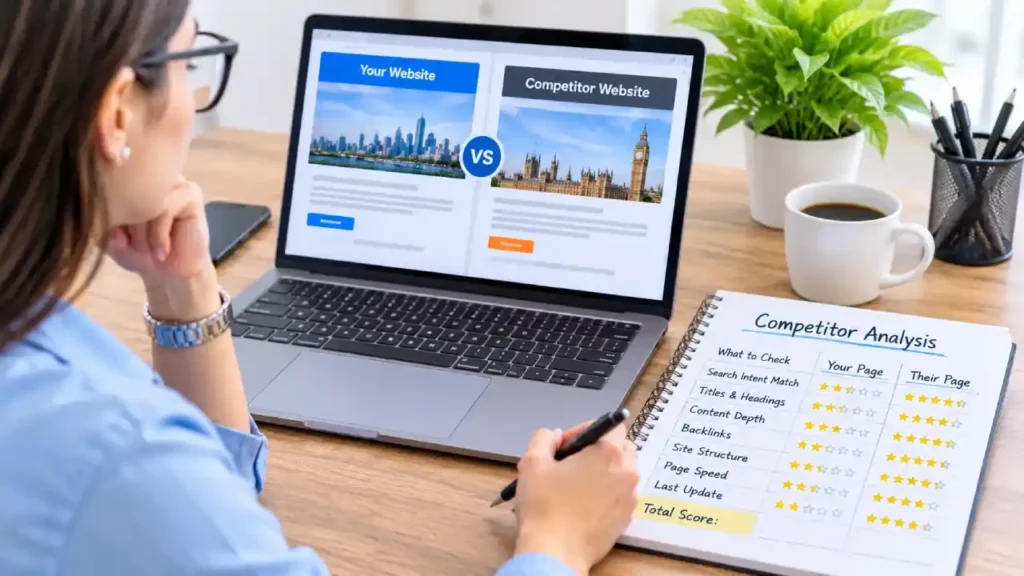
You can score both pages in about 15 minutes. Search your main keyword, open your page and the competitor’s page that ranks above you, and rate each one from 1 to 5 using this key:
- ⭐ 1: Missing or clearly weak.
- ⭐⭐ 2: Basic, with obvious gaps.
- ⭐⭐⭐ 3: Fair, does the job, but nothing more.
- ⭐⭐⭐⭐ 4: Strong, with small improvements possible
- ⭐⭐⭐⭐⭐ 5: Excellent, hard to beat.
| What to check | Your page | Their page |
| Search intent match | ||
| Titles and headings | ||
| Content depth | ||
| Backlinks | ||
| Site structure | ||
| Page speed | ||
| Last update | ||
| Total |
What to Fix First to Outrank Your Competitor?
You can start with the fixes that cost you the least and move rankings fastest
- Match the page type Google ranks already for your keyword and answer the main question in the opening line to make the AIO optimize.
- See your title and H1 with the main keyword and a clear reason to click.
- Fill the content gap by adding what your competitor has not added, but you can do it as a plus point.
- See the credentials and author bio that show Google trustworthiness.
- Do the proper internal linking, compress the image sizes, and choose the proper category for the GBP.
- Review your top pages every quarter and add the refresh content that shows Google that it continues working on the page.
- You can get backlinks, such as guest posts, niche edits, and digital PR, from sites that are highly relevant to your website.
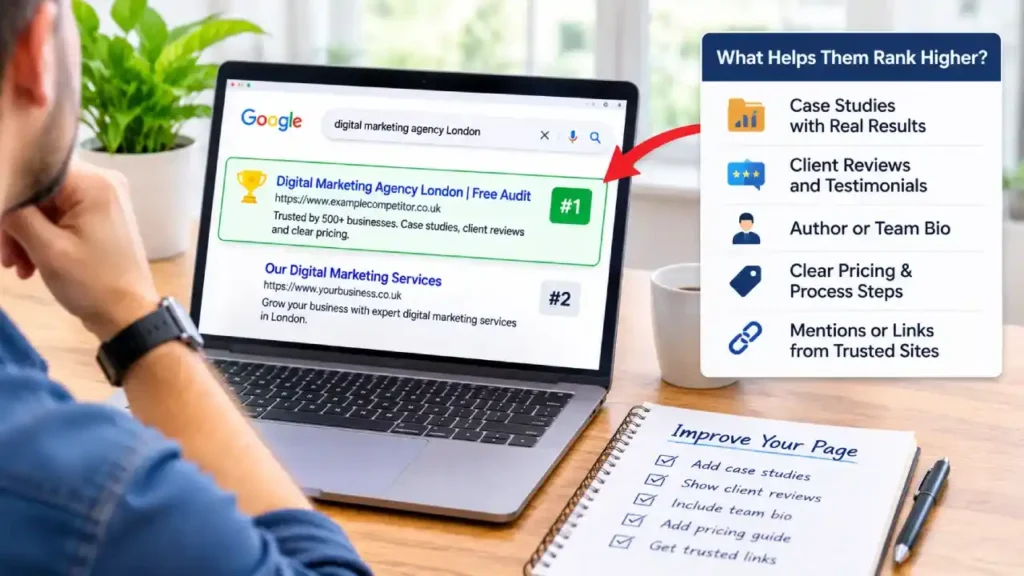
Why Is My Competitor Ranking Higher When My Business Is Better?
It’s because Google ranks pages, not businesses. It cannot visit your offices physically, meet your team, or see how happy your clients are. They can only judge your work through other websites’ remarks about your business and how people behave when they land on your website.
That’s why a page with weaker business can still win if their page does a better job of showing proof. You can improve your quality visibility on the page by adding these required factors:
- Case studies with real numbers and results.
- Client reviews and testimonials.
- An author or team bio showing who does the work.
- Clear pricing cues and process steps.
- Mentions or links from other trusted sites.
How to Find Out Why Your Competitors Rank Higher Than You?
You do not need any paid tools to find the gap in your website. These five checks and a notepad will show you where your competitor pulls ahead.
Pick One Keyword
Start with a single keyword for which your competitor is ranking, but you are not. Don’t try to check everything at once, or it will get messy. For this search, use your keyword in an incognito window and note where each of you ranks.
Match the Pages
Select only pages that are ranking and compare them. Open them side-by-side and check their title, headings, images, proof, and links to other pages.
Read Search Intent
Look at everything Google shows for the keyword. Is it mostly service pages, guides, comparison lists, or map results? If nearly every result is one page type and yours is another, you’ve probably found the first clue.
Use Search Console
Open the performance report in GSC and filter by your page and the keyword that you are comparing with the competitor. You can look at impressions, clicks, and average position. If you find a keyword with many impressions but few clicks, this points to a weak title or description.
Bigger Competitors
If the competitor is a macro brand, then don’t try to match their whole site. You have to just compare it with the single page that is ranking and judge it on intent, depth, clarity, or proof.
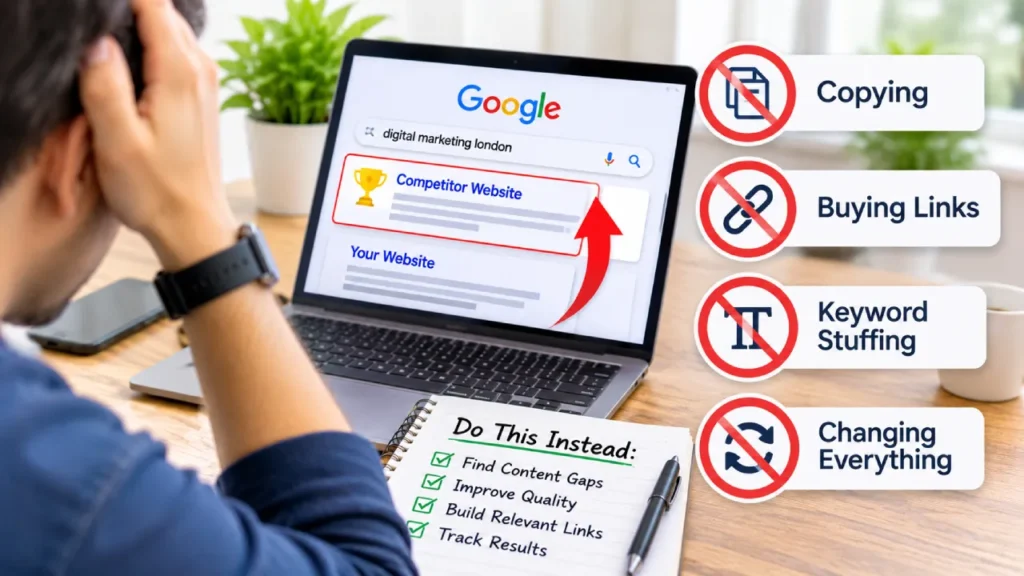
What Not To Do When a Competitor Outranks You?
Sometimes people, due to fear of falling behind, rush and do things that make the gap worse.
- Copying: They unintentionally start copying the competitor, but in reality they should see what gaps they have left and what they have covered.
- Buying links: Mostly, some people start buying backlinks because they think that, due to authority, Google will rank them, but it leads to penalties if the links are not relevant.
- Keyword stuffing: When you are maintaining the keyword density, do not do repetition of keywords because it drops the quality. Use it where it fits naturally.
- Changing everything at once: If you rewrite the complete content site within a week, then you have no idea which page is affected and which is not. Change one page or element at a time and track the results in Search Console.
How Long Does It Take to Outrank a Competitor?
Most sites see measurable improvement in 3 to 6 months. But nobody can promise an exact date because it depends on how strong the competitor is, how old your site is, and how big the gap is.
Small changes like a better title or a refreshed page can show results in a few weeks. New content and links take longer because Google has to find, crawl, and trust them. You can track the progress of keywords in Google Search Console and judge them over the months, not the days.
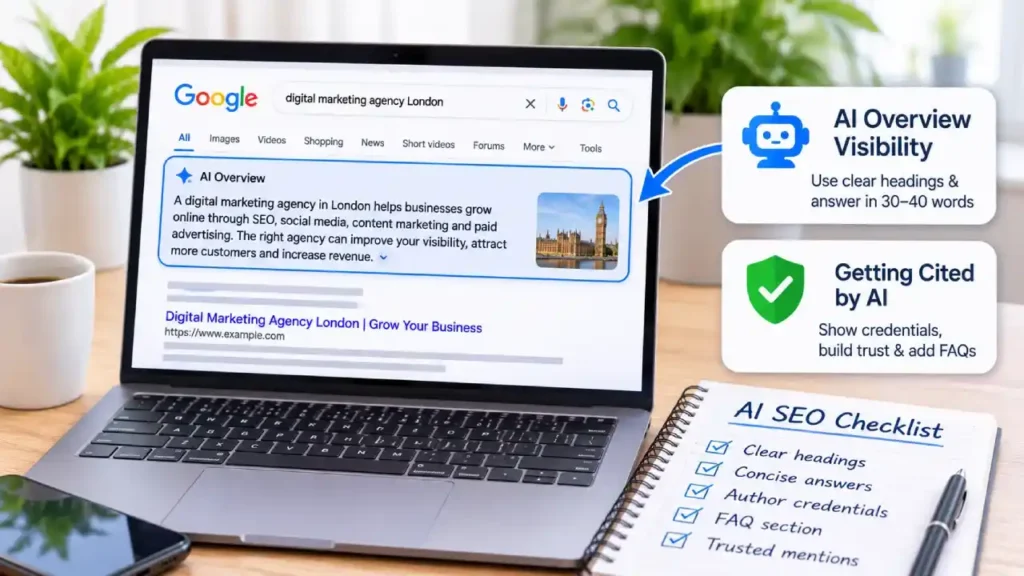
How AI Search Changes Why Competitors Rank Higher?
AI answers now sit above the normal results for many searches. Your competitor can win a place in them even when they rank only slightly higher than you, so the gap is worth closing.
AI Overview Visibility
In the AI overview, mostly those pages that are ranking already and answer the question clearly. That’s why you should use clear headings and answer them in the first 30 to 40 words. Keep each heading focused on one point, and do not overlap the content, even within the page. AI models pick pages that are easy to read for people.
Getting Cited by AI
AI tools favor sources that look trustworthy and show who writes the page. If the proper credentials are added, these will help increase the EEAT factor. Get your brand mentioned on other sites in your relevant category. Add an FAQ section that answers the questions in two to three sentences directly.
Competitor Ranking Gap Checklist
Your competitor ranks above you for a reason, and this checklist helps you spot it. Open your page and the competitor page that ranks above it for the same keyword, then tick every line where they are ahead. Each tick is a gap, and the score at the end shows where to start.
Want to run this check on your own page? Download the free Competitor Ranking Gap Checklist and tick off every gap in about 15 minutes.
competitor-ranking-gap-checklist.pdf
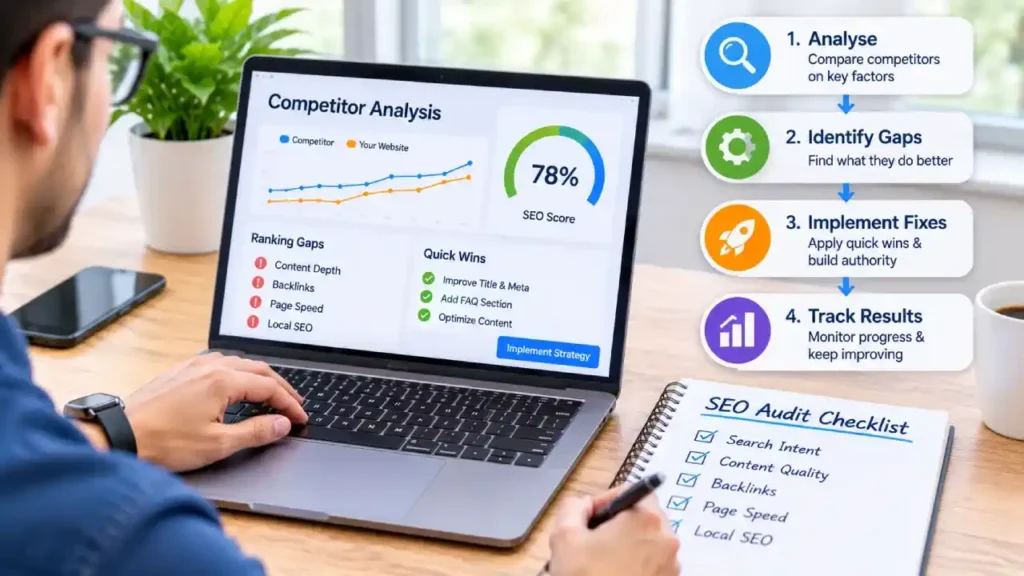
How 360 Web Solutions Finds And Closes Ranking Gaps?
We start with the page that ranks above you and compare it with yours on search intent, content, link structure, speed, and local signals, then mark every place it pulls ahead.
Then we fix according to impact and do quick wins like titles, descriptions, and content gaps first. Link building and local trust also run in parallel because they take longer to build.
Want to see where a competitor is beating you? Book a free SEO audit, and we will show you how.
Conclusion
A competitor outranks you because their page fits the search better, shows more proof, or earns more trust than yours. The quality of your work doesn’t come into it, because Google can only judge what it sees on the page. Pick one keyword and compare the two pages with the checklist. Fix the section with the most ticks first, and give links and local trust time, since they take months.
Frequently Asked Questions
01 Can a New Website Outrank an Older Competitor?
Yes, a new website can rank if it has proper, updated content and proper off-page SEO. It’s not easily possible for the biggest keyword, but for a nano keyword of the main keyword, it can be done easily.
02 Why Does My Competitor Rank Higher With Worse Content?
There are chances they have done proper off-page SEO with stronger links from high-authority, relevant websites. It means weaker content can rank if the other factors are covered correctly.
03 Do Backlinks Matter More Than Content?
These two ranking factors are important because good content gets you into the race, and links help you pass pages with similar content. For a page that matches the search well, links often make the difference.
04 Why Is My Competitor Above Me on Google Maps With Fewer Reviews?
Google not only sees reviews, but it also checks your primary category and how close you are to the searcher. It reviews your Google Business Profile. A competitor with a proper category and full profile can outrank you.
05 Does Longer Content Always Rank Better?
This is not fixed if content is longer; it will not rank easily. It’s because it depends on user intent satisfaction and whether it’s easy to read. If the user gets the answer to their query, then Google will automatically rank it.
06 Can I Fix This Myself, or Do I Need an SEO Agency?
You can fix a lot by yourself, such as content and on-page SEO, but for off-page SEO, you can hire an SEO agency that is more experienced in the field and can create a proper strategy.
07 Does social media affect my Google ranking?
Nothing happens in this way because Google never says it will count the likes, comments, etc. as ranking factors or count them as clicks. But if you share the post, someone clicks on it, and you go to your website, then it counts as a click, and you can get more traffic than organic.
08 How to outsmart your competitors?
Study the page that is ranking above you and deeply analyze what they are covering and what their gaps are. Build a page that answers most of the readers’ questions. If the competitor is bigger, then you target narrower searches first, like a single area or service page
09 What is the 80/20 rule in SEO?
The 80/20 rule in SEO means about 20% of your pages bring in about 80% of your results. Find the pages that already drive traffic or inquiries and improve those first.